Norton Safeweb

Tuesday, January 15, 2013

America's beverage consumption

Looking at trends is always interesting. What do we drink?

The big winner for liquids consumed by Americans is bottled water. Though that's getting some push back now because of all the empty plastic bottles created by this craze.

Other winners: Liquor and wine. In the liquor market the premium ones have fueled the growth while sales of the cheap stuff is in decline. The makers of liquor had to do something as sales were at an all time low in the mid-1990s (except for the Prohibition years). Are you old enough to remember when whiskey pretty much meant Canadian Club or Segram's Seven and tequila meant José Cuervo?

Beer sales peaked around 1980 and have been declining since. However, the craft beer market continues to climb with double-digit growth. It's still only about 6% of the market, but there are about 2,000 breweries in the U.S. now.

Sure is nice to have all these choices
from Russian River Brewery

Per the Beverage Information Group 90% of purchased liquids is made up of soda, bottled water, coffee,  milk, and beer.

Premium wine sales are expected to continue to grow. The trend towards cheaper wine at the beginning of the recession is turning around as under $10 wine sales are declining while over $10 sales are increasing. Many California wineries want to raise prices as inventories are low after several years of smaller than average crop sizes plus increasing costs for grapes. Most are still afraid to raise prices in the face of a continuing recession, but they won't hold off forever.

Overall the average American drinks less than two gallons of wine per year, but consumes 40 gallons of soft drinks and 25 gallons of coffee! I suppose 12 ounces of coffee every morning is better than 12 ounces of Chardonnay, huh? But that's a lot of soda. The other interesting stat is even though Americans rank low on the list of wine consumed per capita at less than two gallons per person, 90% of the wine consumed is by 20% of the people. This means us winos are in the minority, but at least we're holding up our end! The other thing that "holds us back" in consumption is the U.S. has a large percentage of non-drinking adults, almost 40%.

For better or worse, more people drink now than a decade or two ago, but they aren't drinking more, they're drinking better. For instance, maybe a couple IPAs from a local microbrewery instead of a six-pack of Coors Lite. Last time I had a Coors? Many years ago at a pool party. The last time I had a microbrew? A couple days ago. Maybe more telling is I've never seen my kids (yes, they're over 21) drink a cheap American beer. Or maybe they just won't around me knowing they'll be scorned.  :)


Saturday, January 12, 2013

The Gay Wine

It's no secret the marketing guys target products at certain groups. In the recent past there are wines for the younger set, even some for women and some for men. There's Flirty Wine and Bitch Wine along with Sledgehammer. The first two targeted at women, the last at men, in case you weren't sure.

Now there's an official gay wine. Somebody thought, "Hmm, with the legalization of gay marriage catching on around the country we should profit from this."  So we have Égalité to celebrate your same-sex marriage.

Yes, we're waiting for the first "fruity wine" joke.

Huffington Post article


Friday, January 11, 2013

Oh no, we've PO'ed the French (again)!

When California wine became popular and started competing with the French wines those folks noticed we had wines called Chablis, Burgundy, and Champagne. For many decades Americans called basic white wines Chablis, reds Burgundy, and sparkling wines Champagne. The French were not happy to have their high-priced Burgundies confused with Gallo Hearty Burgundy.

We now have an agreement to not use French wine districts in the names of our products. Some wineries on this side of the pond were grandfathered in. For instance, "everybody" called it Korbel Champagne so they're allowed to continue. By law they have to include in the name the region it came from as in Korbel Brut California Champagne.

Well, when the menus for the Inaugural Dinner were printed up one of the wines listed was "Korbel Natural Special Inaugural Cuvée Champagne, California." Note that is says "Champagne, California" not "California Champagne." OMG that's backwards! And some French lobbyists (why are there French lobbyists in DC?) had a fit.
Don't drink that! It's not French!

The labels on the wine are printed correctly, just whoever did the menu didn't know the law verbatim.  The spokeswoman for Korbel basically told them to get a life.

Article in the Santa Rosa Press Democrat

Wednesday, January 9, 2013

"Wines that age longer are better"

Ah, wine collecting. Why do people do it? Besides to show off, that is. It's because the best wines have to age for years before you can drink them. Damn, that's inconvenient!

What other product would you put up with that? You don't hold on to a new album until it's at its peak "listening" time. You don't order out Chinese for next year--it's for tonight.

The good news is there's a couple problems with the statement, "the best wines have to age for years." In previous decades the top wines (they're French red wines, of course!) were made in a style that would be described as hard, acidic, tight, and tannic. So not only did you have to age them correctly for years to get them to their peak drinking, but they weren't even very drinkable in their youth. Well, ain't that a pain in the rear? So you have to store them at the right temperature, humidity, and for just long enough. How long is long enough? How long is too long? What happens to the wine if say, several years in to it's aging it happened to get exposed to a few hours of heat and sunlight. Is it ruined? Do I drink it now or continue to wait for another decade?  Jeez.

You could do this--or you could just drink it
Heck, you could be dead before this stuff's ready!
Image from timesunion.com
Along comes the New World Style pioneered in California and Australia where your typical Cabernet is good within five years of it's vintage date and maybe earlier. Sacrebleu! These wines can't be as good as the Old World style! I mean, the longer a wine needs to age the higher quality of a wine it is, right? Well, some folks still cling to that notion. But if you look at American wine drinking statistics most wine is consumed within 48 hours of purchase. So you have to think the New World style winemakers might be on to something.

For every person who thinks a wine that ages for 25 years is better than one that is best at its release there are 100 more that won't wait and probably don't care about aging. And there's a few of us that see the New World style as correcting a flaw in the Old World way of making wines. While they were at it the New World winemakers pretty much got rid of brettanomyces, volatile acidity, sulfur, and other flaws in wine.

So if your ever driving across I-80 in California near the town of Davis give a wave and a thank you to the University of California at Davis, arguably the home of New World style wines.

Saturday, January 5, 2013

How to become a wine connoisseur

You have to know people.

That is, acquaintances that are wine "experts."  Everywhere you see the word "expert" here you will see the quote marks around it denoting the fact that you and I don't know any real wine "experts," just people that think they are or at least you think they are.

You should subscribe to wine magazines because those writers drink a lot of wine and must be "experts."

Drink a lot of wine yourself. Don't worry about over-consumption because as the saying goes, "It's not alcoholism if I only drink 92 point wines." Worry about your wallet instead.

Taste wine at wineries, retail wine shops, and wine bars. You definitely won't have an alcohol problem if you're only tasting. Worry about your wallet though as you will be tempted to buy some $50 bottles.

See, he's not enjoying it
He must be a connoisseur!

Go to a wine auction, but leave your wallet at home. This is almost as bad as attending a car auction as you could wind up spending as much on that old French wine as you would on a '70 Chevelle.

Take notes when you taste. You'll look like an "expert."

Buy some Riedel wine glasses--at least four different styles. Don't be caught drinking Sauvignon Blanc out of a Pinot glass!

Start a wine cellar and put your inventory on Cellar Tracker so others can see what you have. I believe a minimum of 500 bottles is required to reach "expert" class.

Drink French wine because the word "connoisseur" is a French word meaning "you know something." No, that doesn't sound like expertise, but it always sounds better in French!

Wednesday, January 2, 2013

January in Dry Creek (photos)

January 2, 2013 in Dry Creek Valley, Sonoma County
Click on photos to enlarge

From Mauritson Winery
 
Passalacqua Winery

Passalacqua

At Passalacqua Winery you can apparently buy your own vine!

Tuesday, January 1, 2013

Top Wine Stories of 2012

Some of the biggest stories of 2012 from a California perspective

  • A poor European harvest that will lead to shortages and higher prices. The smallest harvest in half a century will hit consumers in the coming years.
  • Abundant California harvest that may help fill the gap left by the bad harvest in Europe. Meanwhile near perfect weather in CA (after several mediocre years) set up a high-quality and high-quantity harvest. Will California wines fill the gap left by European shortages? This looks like a good thing for CA.
  • Predictions on upcoming grape shortages in California and a vineyard buying spree. A group of wine business people decided there will be a grape shortage in the coming years. Not sure what data this was based on or if it includes the huge supplies of less expensive grapes from the Central Valley as well as premium coastal grapes. It probably means not all wines and all varieties will have shortages, but it has done a couple things. One: grape prices went up immediately meaning higher wine prices are coming. Two: The big boys with the money (such as Kendall-Jackson and Gallo) are going on vineyard buying sprees to be sure they will have grapes in the future.
  • It's getting easier to buy wine as direct shipping to consumers improves. Some states are loosening up their archaic wine shipping laws, like New Jersey. Amazon entered the market with an online wine store.
  • New wine trends: Pinot Grigio, Muscato and Rhone-style blends. Wine style trends come and go. Currently, there's growth in a simpler slightly sweet white for people tired of Chardonnay (Pinot Grigio), for people who want something sweeter (Muscato), and for an easy drinking, but interesting red wine (Syrah and Grenache-based blends).
  • Ben, the bachelor wine maker, picking through the lovely Bachelorettes. Okay, I didn't say they had to be good stories, just ones that everyone is talking about.

Thursday, December 27, 2012

California sparkling wine under $30

It's almost New Years Eve as this gets posted and many of you are thinking about getting a sparkling wine for the celebration. What to get without spending a bunch of money? Oh yeah, and it should be a good bubbly.

If you're willing to spend about $20 to $30 you can get a very enjoyable wine. Here's some ones I turn to:

Chandon in Napa Valley has a line of what they call classic sparklers, but also have a reserve line of Brut, Blanc de Blancs and Rosé all retailing at $30.

Domaine Carneros Brut is a vintage-dated sparkler, 2008 is the current release, that retails for $28.
Best for the money
Image from rodererestate.com


Gloria Ferrer non-vintage Blanc de Noirs is a great deal at $22.

Korbel organic Brut is not the same as their regular Brut you see in every wine shop and grocery store in America. The organic Brut is a nice wine for $16 and is a very worthwhile step up from the $10 junk you'll find in the store.

Roederer Estate Anderson Valley Brut. This non-vintage wine retails for $23 and is definitely a best buy at this price. This is one I can always trust to give me bang-for-the-buck.

Schramsberg Mirabelle. A non-vintage Brut retailing for $25 from the folks in Napa Valley that make the best bubbly in California.

If you're willing to spend a bit more try Iron Horse Wedding Cuvee for $38, a Blanc de Noirs. If you want to go cheaper find the Spanish sparkler, Freixenet, that goes for under $10.

Your prices and availability will vary depending on where you reside.

So what are all these weird terms you find when shopping for a sparkling wine? I blame the French. :)

Brut Dry (less sweet). Typically a blend of Chardonnay and Pinot Noir. By the way, Extra Dry is actually sweeter than Brut. See what the French have done?

Blanc de Blancs means "White from white." It's made from white wine grapes, usually Chardonnay.

Blanc de Noir "White from dark." Made primarily from red wine grapes, usually Pinot Noir.

Champagne is sparkling wine from the Champagne region of France. American producers used to call their sparklers Champagne, but we now have an agreement with the French not to do that. Some American producers were grandfathered in and still label their bubblies as American Champagne.

Cuvee A blend of wines for Champagne, oops I mean sparkling wine.

Methode Champenoise Sparkling wine has a secondary fermentation. That is, after the grape sugars are fermented to alcohol there's a second one to create the bubbles. If this is done individually in each bottle it can be called Methode Champenoise. These are the only ones I'll drink. The "bulk method" processed sparklers give me a headache. You've been warned!


Saturday, December 22, 2012

Leaving wine for Santa

It's traditional to leave cookies out for Santa Claus on Christmas Eve and maybe some carrots for the reindeer. You know, I bet ol' Saint Nick gets pretty tired of cookies after the first thousand or so.

Leave him a glass of wine instead.

So what kind of wine should you leave for him? When trying to decide what to open you should think about the people who will be drinking it and the situation. The situation being: Is it hot out? Cold? Is this for dinner? And what are we eating? Is for for an afternoon social?  Etc.

Santa is spending the night going up and down chimneys so he's out in the cold then into the warm homes.  Two wines come to mind on cold nights. One, a heavy red like a Cabernet. Two, a Port. After all, snow and fireplaces are made for Port! If you're going to leave out some Port I'd suggest matching it with a chocolate chip cookie.

Of course, he may get tired of wine during the night so as an alternative maybe a nice American Black IPA. These are kind of a new trend in wintertime brews.

Take care of Santa and he'll take care of you!

Santa was spotted last January at this tropical bar.
It's believed there was rum involved.

Wednesday, December 19, 2012

Cab -> Merlot -> Pinot Noir -> Grenache?

  There are always "in" wines such as Pinot Grigio seems to be now. This changes every few years. At one time in California it was Chardonnay or Cabernet and that was about it. Sure, there were other things planted like Chenin Blanc and French Colombard, and some Zinfandel mostly for the locals, but the big guys in the market were Chard and Cab.

  Along came The French Paradox on 60 Minutes and all of a sudden it was Merlot as everyone needed a red wine that was drinkable on the day they bought it (not like the Cabs of the time). Merlot rode that wave for about 15 years. Then it was Pinot Noir. Some say because of the movie Sideways that praised Pinot and derided Merlot.

  Pinot has been riding that popularity wave right into the $50 a bottle range. There's a lot of Pinot being produced now. Is its price sustainable? My guess is no. Not that I'm even close to being an expert on it, but I've been a CA wine drinker for a long time and seen the trends come and go. 

  I've noticed interest moving towards Rhone varietals and specifically Grenache. It can be a good food wine, Grenache is a wine you can just sip on or have with a meal, and most importantly it doesn't cost an arm and a leg. The Next Big Thing in red wines was going to be Syrah, but that was a bit of a bust. Why? Well, it's usually a good food wine, but not so good for sipping (it's tannic) and not necessarily cheap--except for the Australian Shiraz style. 

  Grenache seems to grow well in a lot of different locations in California from coastal to the interior Sierra foothills. Yeah, you can find a $40 one if you look hard, but most are around $20. The best ones are often blends of Grenache with Syrah and a lesser known grape Mourvedre--and maybe even Petite Sirah and Carignane. The blends are interesting and very drinkable and if the prices stay low they may even become popular!

Wednesday, December 12, 2012

Ingredient labeling on wine bottles

A topic that comes up now and again is, should wineries have full disclosure of what goes into the bottle? It's just grapes, right? Well, no.

I suppose it starts will the bins of grapes coming into the wine making facility with the bees, earwigs, and spiders plus additional Material Other than Grapes. But no, that's not what we're talking about here. The folks kicking around the idea of full disclosure on wine labels are in favor of things like added acid, water, sulfur, tannins, whether egg whites are used to fine the wine, other chemicals added, maybe even yeasts and oak chips, etc.
There's a bit more to winemaking than this
Image from nelsoncountylife.com

This doesn't get much support. Why? For one, the winemakers (or any other business person) would just as soon keep the government out of their business as much as possible. For another, I believe certain wineries could be a bit embarrassed and maybe think they'll lose business if they actually list everything that went into their wine.

In fact per American law for a wine to be called by a certain varietal name, like Chardonnay or Cabernet Sauvignon, it must contain 75% of that particular grape. It doesn't matter what grapes make up the other 25%. Your Pinot Noir might be 80% Pinot, 15% Petite Sirah, and 5% Chenin Blanc. Not that anyone has ever done that, but it's not illegal.

Then you get into processes, rather than ingredients, like removing alcohol. Do you add that to the label? The wineries definitely don't want to see this. How about any chemicals used to spray the grapes? Nobody else does this so grape growers won't, but then there's things like organically grown, organic wine, and sustainably farmed. What exactly is the difference?

The biggest embarrassment is probably the addition of water to the wine. This is a fairly new process. It started with the ripe fruit style of wines that's become so popular in the last decade or so. The grapes are picked later (riper) to get that bold fruit. After fermentation there is more alcohol from the higher sugar levels so the popular method of reducing this is to just add water to dilute the wine. This process doesn't get talked about much by wineries because they believe it to be a negative with the consumer.

There can be a lot of chemistry especially when the fruit isn't particularly good. But do we need to know all this? We probably don't need to know it as there's no public danger, but more and more Americans want to know what goes into their body.

Thursday, December 6, 2012

What sells wine on a store shelf?

The marketing experts can, of course, give you mountains of data about this or that marketing strategy and branding efforts until you want to scream. This is just an amateur guess at what sells. But then marketing is as much of a guessing game as weather prediction.

Shelf Talkers
That's those little tags under the wine saying "93 points!" or "Great with steak!" When you're looking over a selection of 20 Cabernets in your price range you are going to take the one getting 94 points over the one that only got 89, right?
Look at all the awards! This stuff must be good!


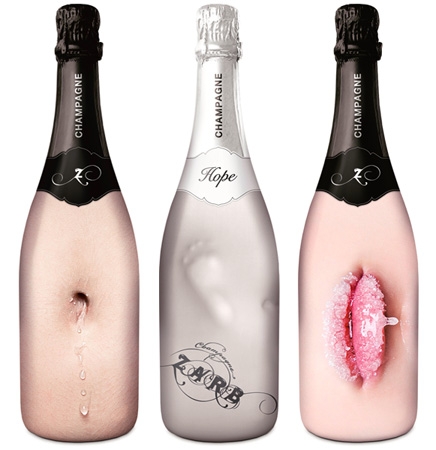
Label
Wineries anguish over going with the simple, and cheaper, two color label vs. bright colors with nice pictures. People will admit to buying by the label all the time. Some folks have a reputation and don't require a fancy label. There are lots of European labels that are dull, colorless, and crowded with script.
Someone that doesn't need to stand out on the shelf
Image from delingerwinery.com
Zarb Champagne. Someone that, um, wants to stand out
Image from polkadot.it

Winery Name
Give it a made up fancy hard to pronounce name that sounds Italian, German, or better yet, French and you can sell it for more dollars than you can something called Sassy Bitch or Happy Bitch (both real labels). With names like that they had better be cheap. No one is going to spend $30 for a bottle of Fat Bastard Shiraz.
Just not really an appealing name, you know?
Image from winehouse.com.au